David Mitchell
The Cookie Monster has been outed as an emblem of the far right, but why stop there? How about Hawaiian shirts?
 If I told you that extreme rightwing activists were using a
googly-eyed character with a weird flapping mouth to try and build their
support base, you'd probably tell me to stop being rude about Nigel
Farage. Or applaud me for being rude about Nigel Farage. But for once
I'm not slagging off Ukip's straight-talking bitter drinker. I'm
referring to someone who, as far as we know, has never touched beer or
cigarettes, which is probably a good thing as he seems to have rather an
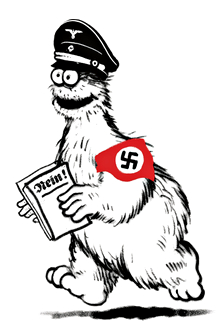
addictive personality. It's the Cookie Monster from Sesame Street, surely the world's most lovable personification of an eating disorder, whose image has been adopted by a group of German neo-Nazis in an attempt to recruit children.
If I told you that extreme rightwing activists were using a
googly-eyed character with a weird flapping mouth to try and build their
support base, you'd probably tell me to stop being rude about Nigel
Farage. Or applaud me for being rude about Nigel Farage. But for once
I'm not slagging off Ukip's straight-talking bitter drinker. I'm
referring to someone who, as far as we know, has never touched beer or
cigarettes, which is probably a good thing as he seems to have rather an
addictive personality. It's the Cookie Monster from Sesame Street, surely the world's most lovable personification of an eating disorder, whose image has been adopted by a group of German neo-Nazis in an attempt to recruit children.


