Εμφάνιση αναρτήσεων με ετικέτα DEVELOPMENT. Εμφάνιση όλων των αναρτήσεων

Σάββατο 17 Σεπτεμβρίου 2016

Three reasons why Belarus is on investors’ radar

After years of economic crisis and anaemic growth, Belarus is becoming an attractive destination to foreign investors.
Three reasons why Belarus is on investors’ radar
Belarus has been receiving an increased attention from investors of late. Having weathered several heavy economic crises is in the mid-1990s, an ongoing process of implementing structural economic reforms has seen it slowly shirk its reputation as a Soviet-era authoritarian regime with centralised economic planning. While many reforms in the field of economic liberalisation still need to be implemented, the country is actively seeking to improve its international standing and attract foreign investment.

Τετάρτη 30 Δεκεμβρίου 2015

Projecting progress: reaching the SDGs by 2030

This flagship report offers the first systematic attempt to project progress across the full Sustainable Development Goal (SDG) agenda, showing where – if current trends continue – the world will be in 15 years’ time. Our findings serve as a wake-up call on just how much more effort will be needed to reach the new goals. 
SDG scorecard
Gathering together the best available projections, we provide a ‘scorecard’ against 17 targets – one per goal. This shows that, without increased effort, none of the goals and examined targets will be met. The scorecard reveals how much faster progress will need to be, classing targets as needing ‘reform’, ‘revolution’ and ‘reversal’. 

Δευτέρα 21 Σεπτεμβρίου 2015

Four principles for Theories of Change in global development

The stratospheric rise of the Theory of Change approach continues. In a new paper published today, I argue that taking a Theory of Change approach demands a radical shift towards more and better learning in development thinking and practice.


Hang on, do we know what a Theory of Change approach actually is?

Παρασκευή 7 Αυγούστου 2015

5 things needed to turn the SDGs into reality

Now that the sustainable development goals are — in the main — agreed, what needs to happen to turn this global manifesto into a national policy agenda?
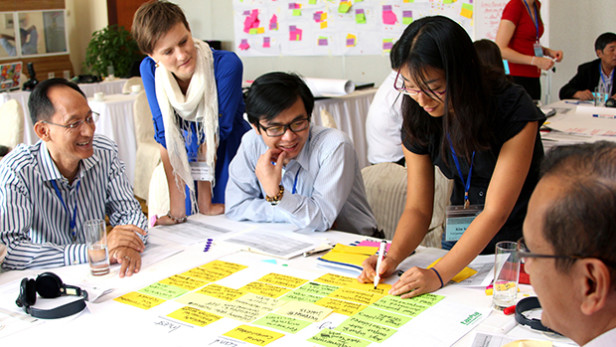
Members of development organizations, governments, private sector, civil society and academia work together at the WCMC Scenarios Workshop to outline ideas on future socio-economic drivers of change for food security, environments and livelihoods in Southeast Asia. Photo by: CGIAR / Elisabeth van de Grift / CC BY-NC-SA
The clock to SDG attainment will start ticking Jan. 1, 2016. Here are five things that will be important to ensure the much-debated goals and targets — and the overarching vision of a new future for everyone — actually start to be implemented.

Κυριακή 26 Απριλίου 2015

Financing the future: How international public finance should fund a global social compact to eradicate poverty

Financing the future illustration

This year the world will agree new Sustainable Development Goals (SDGs) to shape global development policy until 2030. Achieving these goals would have transformative effects, eradicating the scourge of global poverty and expanding opportunities for many millions worldwide. Success will require political leadership backed by financial commitments.

Παρασκευή 13 Μαρτίου 2015

How to Make the Sustainable Development Goals Work

The two of us met for the first time more than a decade ago, in 2003, in the small rural village of Momemo, an hour’s drive and a world away from the urban bustle of Maputo, Mozambique’s capital and largest city. We were there to gain a deeper understanding of the impact of malaria on the lives of villagers in areas particularly hard hit by the disease.
How to Make the Sustainable Development Goals Work
But as we sat outdoors talking with a small group of villagers, the conversation covered a range of issues about the health and well-being of women and children in the village. How early did women marry here? How many children did they have? How many children had they lost to illness? Could they work and care for children severely sick with malaria?

Σάββατο 1 Φεβρουαρίου 2014

Data Revolution: Development's Next Frontier

Governments have been collecting data on their citizens almost from the first moment that they came into being. Data was needed to determine what was out there that could be extracted: The Egyptian Pharaohs conducted a census to find out the scale of the available labor force to build the pyramids, and in the Roman Empire, the five-yearly census was all about finding out who was available for military service and what wealth existed to be taxed. But governments have also used data to find out what people needed: The ancient Babylonians collected data from their citizens nearly 6,000 years ago in order to understand how much food was required to feed their population, and the Egyptian census was also used to work out how to divide the land after the flooding of the Nile. 


As the activities of governments have become more complex, and people’s expectations have grown, more and more data has been collected. Early censuses just recorded numbers of people, with basic information about wealth and maybe occupation. It’s all more complicated now—the most recent U.K. census, held in 2011, had 56 different questions. And that’s not even including data collected by the health service, the education department or the myriad other public and private bodies who collect and use information about individuals.

Κυριακή 16 Ιουνίου 2013

Priorities for EU development aid

The world has made considerable progress in promoting economic and social development. But major challenges remain. Around one billion people still do not have enough to eat and lack access to safe water. One and a half billion have no source of electricity.1
Priorities for EU development aid
Europe is a major donor of aid. In European capitals, development aid is more and more considered an instrument of foreign policy, to promote national economic, commercial or strategic interests. These are all legitimate objectives for national governments, but human well-being must not be overlooked. People who lack the necessities to live fulfilling lives must be helped, even if such aid has no commercial or strategic benefit to the donors.

Παρασκευή 31 Μαΐου 2013

The good, the bad and the ugly in the long-awaited UN development report

So, the wait is over. After five meetings, possibly 5,000 pages of submissions, and more than 500,000 people consulted, the high-level panel appointed by UN secretary general Ban Ki-moon to advise on a vision for development after the millennium development goals (MDGs) expire in 2015 has produced its report (pdf).
UN high-level panel report
Looking ahead … Justine Greening, Susilo Bambang Yudhoyono, Ban Ki-moon, and Florence Chenoweth in New York. Photograph: Stan Honda/AFP/Getty Images
The good news: it's clear, intellectually coherent, and moves on the debate about poverty and development without losing what's good in the existing agenda. It offers a clear storyline and an indicative set of goals to provide an example of how this might all translate into a post-2015 agenda. What it doesn't do is spell out the big changes needed to get us there.

Παρασκευή 25 Ιανουαρίου 2013

AP Debate: Training youth key to rebuilding job market in wake of financial crisis

Training the youth for the challenges of a fast-changing world has to be central to any strategy to rebuild the job market following a financial crisis that’s wiped out millions of middle-class jobs over the past five years.
That was the central conclusion that emerged from the annual Associated Press debate at the World Economic Forum in the Swiss village of Davos, which focused on the need to build up skills for a changing economy.

Παρασκευή 7 Δεκεμβρίου 2012

'Limits to Growth' Author Dennis Meadows 'Humanity Is Still on the Way to Destroying Itself'

People scavenging at a dump in India: Where are the limits to growth?

In 1972, environmental guru Dennis Meadows predicted in his seminal study "The Limits to Growth" that the world was heading toward an economic collapse. Forty years on, he tells SPIEGEL ONLINE that nothing he has seen since has made him change his mind.

SPIEGEL ONLINE: Professor Meadows, 40 years ago you published "The Limits to Growth" together with your wife and colleagues, a book that made you the intellectual father of the environmental movement. The core message of the book remains valid today: Humanity is ruthlessly exploiting global resources and is on the way to destroying itself. Do you believe that the ultimate collapse of our economic system can still be avoided?