Δευτέρα 7 Σεπτεμβρίου 2015

The Undiplomats: Right-wing populists and their foreign policies

  • As right-wing populist parties have shifted from being marginal players to important political actors in Europe, they have also turned their attention from domestic to foreign and security policy, in ways that sometimes threaten European interests. Mainstream parties need to find effective ways to counter them.
The Undiplomats: Right-wing populists and their foreign policies

  • Right-wing populist parties disagree on many foreign policy issues. They range from anti-American to pro-American, from Russophile to Russosceptic and from isolationist to internationalist. But they are united on some points, notably euroscepticism. They oppose further EU enlargement and, especially, Turkish membership of the EU.

Lighten the load

Greece’s debt burden needs to be reduced, but maturity extensions on existing loans are not enough for Greece to return to the markets.
Lighten the load

The IMF says that Greece’s debt burden is unsustainable. That is why the IMF will not contribute to the third assistance package (recently agreed by Europe and Greece) unless Greek debt is reduced. The problem is that an outright cut in the value of the debt – a haircut – is politically unacceptable, especially to Germany. The other option – extending the maturity of existing official loans further and lowering interest payments – is not enough for Greece to return to the markets. In order for this to be possible, the eurozone needs to refrain from threats of Grexit in case of a renewed crisis; to commit to making Greek debt sustainable even if economic growth comes in below expectations; and to make new government bonds issued to the market senior to existing official loans, such that new government bonds are serviced before official debt. These measures would also be in the interest of the creditors themselves: only if investors, businesses and consumers feel confident about Greece’s euro membership, can Greece grow and repay its debt.

Europe Rethinks the Schengen Agreement

Forecast

  • Rising immigration and fragile economic recovery in Europe will reduce political support for the Schengen Agreement, which eliminates border controls among member states.
  • The Schengen Agreement will likely be reformed to make room for countries to tighten their border controls more frequently.
  • Friction between Schengen members and other countries will remain, as will tension within the bloc itself.

The UK response to the plight of Syrian refugees is a national embarrassment

Europe once stood for human rights, collective action and the reconstruction of lives shattered by war. Not anymore. Faced with a refugee crisis that leaves the lifeless body of a three year old Syrian toddler washed up on a beach, 70 dead in the back of a van on an Austrian lay-by, and thousands drowned in the Mediterranean, Europe’s leaders are behaving like rabbits caught in the headlights.

Αποτέλεσμα εικόνας για The UK response to the plight of Syrian refugees is a national embarrassment
The time has come for the EU’s citizens to draw a line in the sand. We need a plan of action commensurate with the scale of the displacement. And we need a public mobilisation in defence of our shared values. This crisis is also about us.

"A Debt Relief is Inevitable"

Do you consider that the current Greek bailout deal is going to improve economic and social conditions in the country?

Picture
Marc Chesney 
Professor of Finance
University of Zurich

No, on the contrary. The situation in Greece is catastrophic. Implementation of the policy imposed by the "Troika" has generated unemployment, despair and misery. The wave of privatization generates an absurd situation in which the country's key assets are wasted. Most of the so-called European financial help to Greece goes back to its creditors or is unsuccessfully used for the recapitalization of Greek banks. The debt level is not sustainable. 

Now the truth emerges: how the US fuelled the rise of Isis in Syria and Iraq

The war on terror, that campaign without end launched 14 years ago by George Bush, is tying itself up in ever more grotesque contortions. On Monday the trial in London of a Swedish man, Bherlin Gildo, accused of terrorism in Syria, collapsed after it became clear British intelligence had been arming the same rebel groups the defendant was charged with supporting.
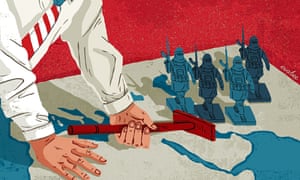
Eva Bee illustration
 Illustration by Eva Bee
The prosecution abandoned the case, apparently to avoid embarrassing the intelligence services. The defence argued that going ahead withthe trial would have been an “affront to justice” when there was plenty of evidence the British state was itself providing “extensive support” to the armed Syrian opposition.

Σάββατο 8 Αυγούστου 2015

«Καπνός» τα δισ. της πρώτης διάσωσης

Ούτε για «τραυμαπλάστ» δεν έφτασαν τα 25 δισ. ευρώ που έβαλαν οι Ελληνες φορολογούμενοι στις ελληνικές τράπεζες το 2013, για να καλύψουν τις κεφαλαιακές ανάγκες και να «διασώσουν» το χρηματοπιστωτικό σύστημα της χώρας. Από τα χρήματα αυτά που επένδυσε πριν από δύο χρόνια το Ταμείο Χρηματοπιστωτικής Σταθερότητας στις τράπεζες, έχουν «απομείνει» σήμερα μόλις 3 δισ. ευρώ και πλέον το ελληνικό κράτος ετοιμάζεται να δανειστεί άλλα 20-25 δισ. ευρώ για να ξανασώσει τις τράπεζες στις οποίες είναι ο μεγαλύτερος μέτοχος.
Σκληρό παζάρι για το πρωτογενές πλεόνασμαΑπαιτούνται άλλα 25 δισ. ευρώ δάνειο στο πλαίσιο της συμφωνίας για την ανακεφαλαιοποίηση. Τα έχασαν όλα και οι ιδιώτες που επένδυσαν επιπλέον 8,3 δισ. ευρώ στις περσινές αυξήσεις κεφαλαίου
Η κατάρρευση των τραπεζικών αξιών στο Χρηματιστήριο τους προηγούμενους μήνες, αλλά κυρίως την τελευταία εβδομάδα όταν και εξαϋλώθηκαν εν ριπή οφθαλμού 8 δισ. ευρώ από την εναπομείνασα χρηματιστηριακή αξία των τραπεζών (από τα 13 δισ. ευρώ υποχώρησε μέχρι τα 4,6 δισ. ευρώ), σήμανε την ολοσχερή απώλεια των χρημάτων που επένδυσαν τόσο οι ιδιώτες επενδυτές πέρυσι (8,3 δισ. ευρώ) όσο κυρίως το ελληνικό κράτος μέσω του Ταμείου Χρηματοπιστωτικής Σταθερότητας.

The Little Anti-Corruption Agency That Could

 The Little Anti-Corruption Agency That Could
December 10, 2010, former Croatian Prime Minister Ivo Sanader was driving with his brother on an Alpine highway when Austrian police stopped his car and arrested him under an international warrant. Sanader had fled Croatia a day earlier, hours before his colleagues in parliament — still led by his own party — stripped him of legislative immunity. The Austrians extradited him back home, where he was facing charges of large-scale corruption. After a year-long trial, he was convicted and sentenced to 10 years’ imprisonment, shortened to eight and a half on appeal, for illegal kickbacks totaling 10 million euros. (In late July 2015, he was granted a retrial.)

China seeks to secure oil supply in the South China Sea

China’s land reclamation is not just rooted in erecting a military and political presence in the South China Sea, but in its desire to safeguard the security of its petroleum supply.
China seeks to secure oil supply in the South China Sea
China’s land reclamation project among the disputed islands in the South China Sea has drawn extensive international attention. While focus has been on China’s military presence, there seems to be another implication of China’s provocative behaviour. In fact, erecting bases within the region is an extension of China’s oil supply security strategy.

Geopolitics come first, and the bailout deal follows

Egypt's President Sisi inaugurated today the "New Suez Canal" ordering a national celebration that drew the attention of international media. The reason is not that much the Canal itself, but the gathering of a handful of political leaders. 
Picture
Egypt was looking to build on a new national narrative that would bring back sentiments of pride and a feeling of regional assertiveness for Sisi. In a tough and complex geopolitical environment, with the war against ISIS to intensify, Turkey and the United States to form a powerful alliance against the jihadists, Iran to transform from rogue state to Middle East regulator, and energy regional struggle to come back in the headlines, Egypt wanted to demonstrate that it remains in the center of global developments, able to construe that whatever geopolitical shifts occur, Cairo remains a center for decision-making in the Middle East and a power that can share global developments and preserve stability in a highly tumultuous environment.