Παρασκευή 27 Νοεμβρίου 2015

ISIS lucrative economy and its donators

“ISIS is a huge financial package to support more 8 million people—which is now the size of the population living in territories under ISIS control... it is also supporting tens of thousands of militants who have been at war for months, with new recruits coming in every day. Yet it keeps all these people answerable to them, seems to have incredible cross-border mobility and shows no signs right now of running out of money or fuel.” says Luay al-Khatteeb, visiting fellow of the Doha Brookings Center and director of the Iraq Energy Institute in Baghdad[1].


Today ISIS controls an area almost as big as then United Kingdom. Having amassed more than two billion dollars[2] since its appearance in 2003[3] it is now the wealthiest terrorist organization. Although, lucrative donations and private contributions started up ISIS, the group has managed to become self funded within a couple of years. It has even put in place the beginnings of quasi-state structures - ministries and law courts. This unpresented pace of income compilation  is based on the following sources of income[4]:

Δευτέρα 16 Νοεμβρίου 2015

South Europe's debt about to explode

The fall of Coelho's conservative forces in Portugal and the preparation for a left-wing coalition government has not been received with enthusiasm in Berlin and Brussels. Not only for political and ideological reasons, but mainly for the fact that after Greece, Portugal is expected to put in question austerity politics in the European South. 

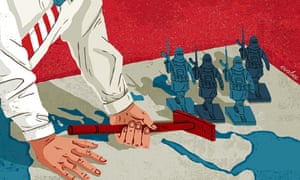
Now the truth emerges: how the US fuelled the rise of Isis in Syria and Iraq

The war on terror, that campaign without end launched 14 years ago by George Bush, is tying itself up in ever more grotesque contortions. On Monday the trial in London of a Swedish man, Bherlin Gildo, accused of terrorism in Syria, collapsed after it became clear British intelligence had been arming the same rebel groups the defendant was charged with supporting.
Eva Bee illustration
 Illustration by Eva Bee
The prosecution abandoned the case, apparently to avoid embarrassing the intelligence services. The defence argued that going ahead with the trial would have been an “affront to justice” when there was plenty of evidence the British state was itself providing “extensive support” to the armed Syrian opposition.

Τετάρτη 11 Νοεμβρίου 2015

What does India think?

India is changing, and Europe is missing out. India is now the world’s fastest-growing economy, ahead of China, and the European Union is both its biggest market and biggest trading partner. The two unions share common values and democratic political systems. Yet Brussels has not found time to meet Prime Minister Narendra Modi, and trade talks are deadlocked.
Rashtrapati Bhavan, the official residence of the president of India. From Flickr.com, User: kkoshy/
Europeans are frustrated by India’s complexity, fragmentation, and changing rules. But, while European firms complain about the difficulty of doing business across the diverse Indian subcontinent, few realise that Indians feel exactly the same about Europe. Indians tend to approach Europe through bilateral relationships with each member state, rather than treating it as a whole.

Will NATO trigger a war with Russia?

Heads of the North Atlantic Treaty Organization (NATO) are considering sending 4,000 ground troops in to Poland, Lithuania, Latvia and Estonia as a response to Russia’s actions in the Crimea and Ukraine. Could war be on the horizon? What are the alternatives to securing peace?       
Will NATO trigger a war with Russia?
If there is one thing we have learnt from history it is that wars are costly and messy affairs. Despite this, is seems as if NATO’s brinksmanship strategy may push America and its European partners into a threatening confrontation with Russia, a situation they have been working hard to avoid.

Continued Crossings Highlight Risks Migrants Willing to Take to Reach Europe

Picture
The number of migrants trying to reach Europe by sea continues to be high, despite worsening weather conditions. While boat crossings typically decrease in autumn, October saw record numbers of people arriving. Over 218,000 people entered Europe by sea last month alone, compared to 219,000 that made the crossing during the whole of 2014.

«Φρένο» στη γιγάντωση των διεθνών τραπεζών


Επιτέλους οι κανονιστικές αρχές διαθέτουν ένα πλαίσιο προκειμένου να διαχειριστούν την κατάρρευση διασυνοριακών πιστωτικών ιδρυμάτων. Χθες το Συμβούλιο Χρηματοπιστωτικής Σταθερότητας (FSB) ανακοίνωσε κανόνες, σύμφωνα με τους οποίους οι τράπεζες θα πρέπει να διαθέτουν επιπλέον κεφάλαια για να είναι σε θέση να αντεπεξέλθουν σε μια μελλοντική κρίση. Ωστόσο η προσπάθεια των κανονιστικών αρχών ανά τον κόσμο να λύσουν το πρόβλημα των τραπεζών που είναι «υπερβολικά μεγάλες ώστε να αφεθούν να καταρρεύσουν» θα έχει κόστος στις τράπεζες που δραστηριοποιούνται παγκοσμίως και για τα επιχειρηματικά τους μοντέλα.

Δευτέρα 9 Νοεμβρίου 2015

Five myths about poverty, growth and inequality

Today, development experts from a range of organisations and universities, including the World Bank, are gathering at ODI to discuss how we can end extreme poverty


'Pro-poor' or 'inclusive' growth ensuring that growth benefits the poor  more than the average  -  is a popular mechanism for achieving this. For example, the Sustainable Development Goals and the World Bank both have targets that aim to promote income growth for the bottom 40% of every country’s population.

25 years on: How the euro's architects erred

A quarter of a century after the euro’s conception, the flaws in its design have become apparent. EU leaders have fixed some of them but the euro needs better policies in order to be a successful currency.
25 years on: How the euro's architects erred

It is almost 25 years since European finance ministers, meeting in Rome in December 1990, launched an ‘inter-governmental conference’ on Economic and Monetary Union (EMU). Their work emerged a year later as the Treaty of Maastricht, which set out a roadmap for creating what became the euro.

Political Climate Shifting Against The Oil And Gas Industry

Oil and gas companies have had a tough time over the past year trying to weather the storm of falling oil prices. But the political and financial winds are moving in the wrong direction for the industry, raising more “above ground” problems at a time that they can ill-afford it.
Political Climate Shifting Against The Oil And Gas Industry
Drilling oil and gas wells requires a lot of money. For companies that have seen their revenues vanish because of collapsing oil prices, access to credit is obviously critically important. But U.S. financial regulators are growing concerned about a pile of energy debt that is deteriorating in quality. A reportfrom the Federal Deposit Insurance Corporation, the Office of the Comptroller of the Currency and the Federal Reserve singled out the oil and gas sector when it concluded that credit risk was rising across the United States.